
When the grid cannot deliver the lowest-cost generation to load, more expensive generation is dispatched instead, raising prices. This cost is reported as “transmission congestion” in organized wholesale markets administered by regional transmission organizations (RTOs) and independent system operators (ISOs). Since 2019, Grid Strategies has published an annual report examining the costs and causes of transmission congestion for the previous year, according to data from RTOs.
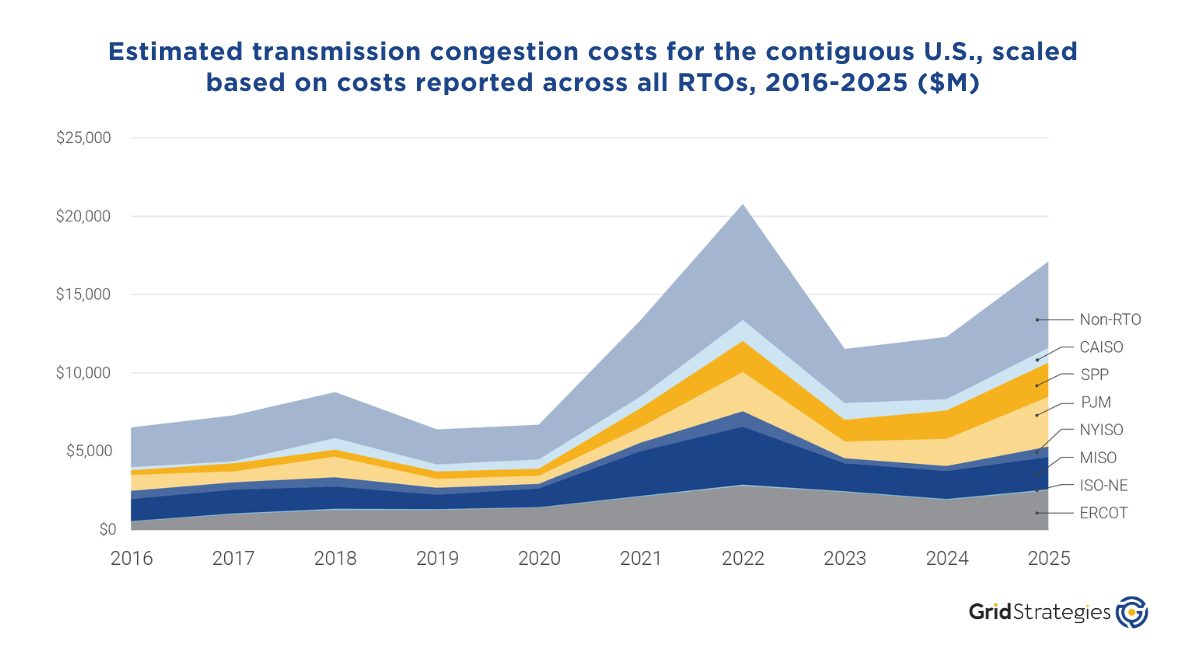
The latest report, “Transmission Congestion for 2025,” estimates that total congestion costs exceeded $17 billion in 2025, up from $12 billion in 2024. Increases in congestion costs do not appear to be a temporary blip caused by high gas prices or bad weather; rather, they are an emerging trend—for each of the last five years, congestion costs nationwide have surpassed $12 billion. Solutions, such as expanding regional and interregional transmission capacity and deploying advanced transmission technologies, can ensure that grid planners across the U.S. are able to reliably and affordably serve growing demand.
About the methodology: This data is compiled using congestion costs reported by market monitors for RTOs. To estimate a national congestion cost figure that includes non-RTO regions, this report scales the known RTO congestion costs in Table C1 in the Appendix according to the peak load of the same regions when compared to total U.S. load.
Past Reports
- Congestion Costs for 2024 (November 2025)
- 2023 Congestion Report (September 2024)
- 2022 Congestion Report (July 2023)
- 2021 Congestion Report (March 2023)
- 2018 Congestion Report (August 2019)
Last updated September 2026.