
Michael Goggin, Grid Strategies
July 21, 2026
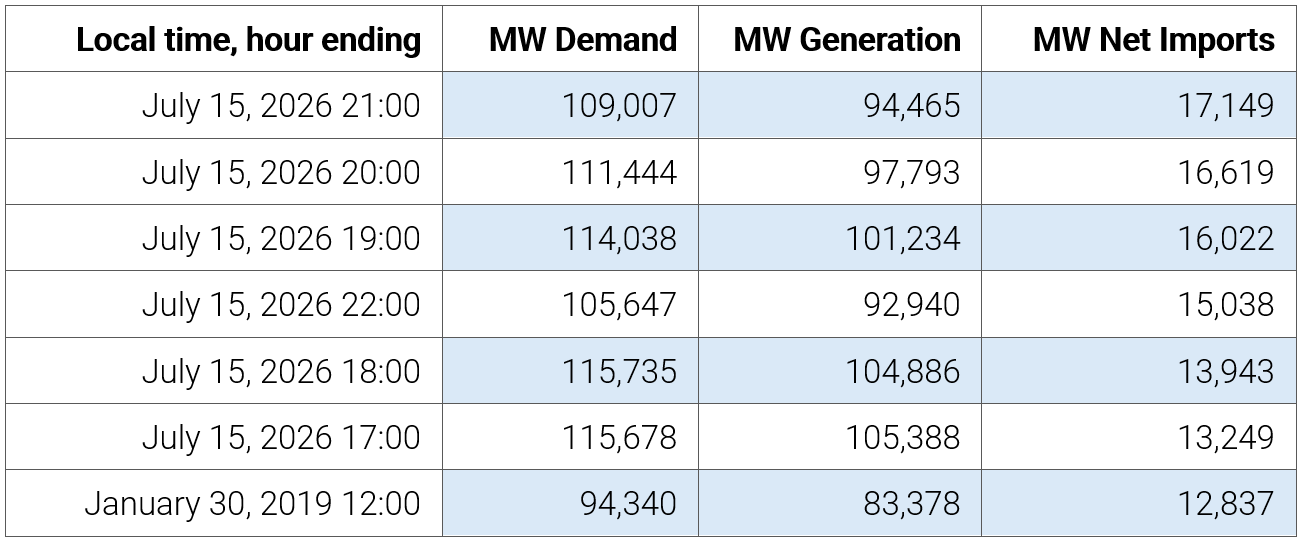
Our power grid kept the air conditioning on as tens of millions of Americans sweltered during last week’s heat wave, passing a critical test. Interregional transmission played an important role in that success by allowing the regions most affected by the heat to buy surplus generation from neighbors experiencing milder weather. The Midcontinent Independent System Operator (MISO) was the most affected by last week’s heat dome over the middle of the country, and MISO set a new record for electricity imports on July 15. MISO’s net imports averaged 17,149 MW during the 8 PM hour, and 17,873 MW during the 5-minute period from 8:25-8:30 CT. As shown in Table 1 below, this eclipsed MISO’s previous record for net imports, set during the January 2019 polar vortex event, by over 4,300 MW.
Table 1: EIA hourly data showing MISO’s highest net import hours
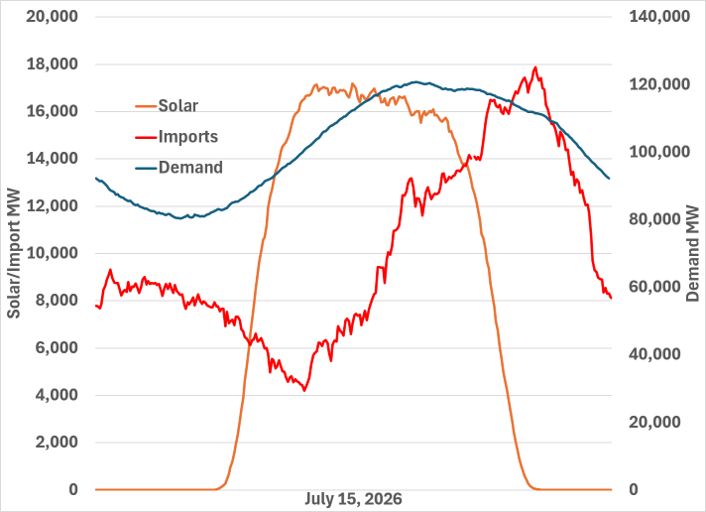
MISO solar output was also high on July 15, as the high-pressure systems that cause heat dome events almost always cause clear skies. MISO solar output was around 16,000 MW as MISO experienced peak demand that day, as shown below. MISO used imports to follow net load (demand minus renewable output) over the course of the day and help fill in during the evening as the sun set.
Figure 1: MISO solar, imports, and total demand on July 15, 2026
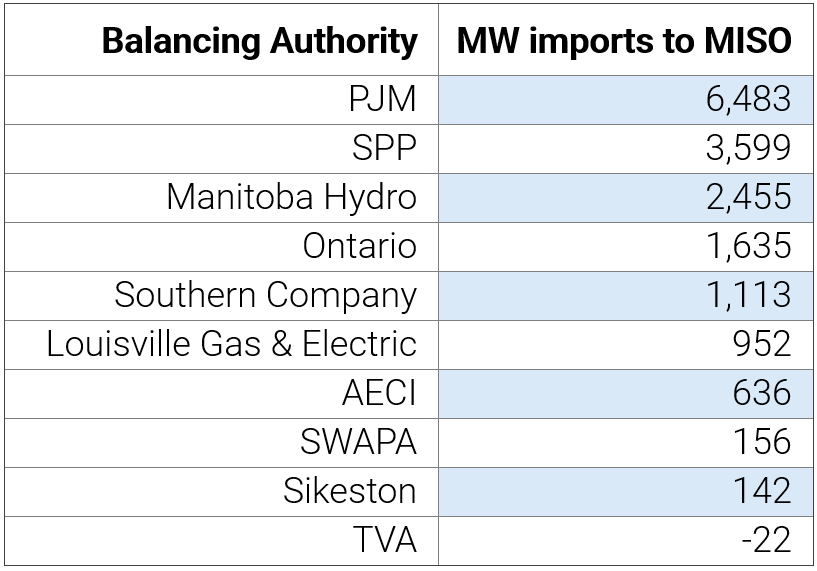
The table below shows the regional breakdown of where the 17,149 MW that MISO imported during the 8 PM hour on July 15 originated.
Table 2: EIA data on regions providing MISO imports during 8-9 PM CT, July 15
This is similar to the benefit interregional transmission has provided by keeping the heat on during recent cold snap events, like Winter Storms Fern, Elliott, Uri, and others. Heat dome events are typically larger than extreme cold events. However, these recent heat waves show that interregional transmission still plays a critical role in cost-effectively keeping the air conditioning on, a finding confirmed by the NERC and DOE studies discussed below. Earlier this month, solar and imports played a similarly important role as PJM faced a significant heat wave, with solar providing over 11,000 MW and PJM importing around 900 MW in total from MISO, New York, Louisville Gas and Electric, and Tennessee Valley Authority as PJM set its all-time demand record between 5 and 6 PM on July 2.
NERC’s Interregional Transfer Capability Study confirms that expanding interregional transmission will be essential for keeping the lights on during both summer and winter peak demand events. DOE’s recent draft Transmission Needs Study (pages 54-61) similarly notes the value of interregional transmission during both heat waves and cold spells.
Adding more solar and battery storage will help grid operators during these summer peak demand events. In states like Texas and California, battery storage already plays a critical role by charging up when daytime solar generation is abundant and then discharging in the evening as the sun sets, helping to fill the role imports played for MISO and PJM during their recent peak net load events.
Diversifying the generation mix with renewable generation, batteries, and imports improves resilience as extreme heat or cold can be challenging for all generator types. During the winter events discussed above, gas generators accounted for the majority of all generator outages, followed by coal. Heat wave or drought events can cause the cooling water that most fossil and nuclear generators rely on to be too hot or in limited supply. For example, 6.3 GW of capacity was offline or derated across eight nuclear units during France’s recent heat wave. Nuclear Regulatory Commission data show that four Midwest nuclear units, including two in MISO and two in PJM, were operating below their maximum capacity the morning after MISO’s peak demand on July 15, potentially due to cooling water constraints. Many gas generators also experience significantly derated output during heat waves when temperatures are high. For example, the California grid operator concluded that the high rate of outages and derates among the state’s gas generators (page 47) was a significant contributing factor to brief rolling blackouts in California in 2020. Since then, diversifying the resource mix with additions of solar, battery storage, and wind generation has ensured the California grid operator has abundant generation during extreme weather events.
In short, a diverse generation mix and interregional transmission that taps into regional diversity are the best solutions for ensuring Americans have affordable and reliable power in the face of extreme weather and other uncertainties.